

Science Adventure (科学アドベンチャー Hepburn: Kagaku Adobenchā) — In Portuguese: Scientific Adventure, is a series of Visual Novels developed by 5pb. and Nitroplus. The series begins with ChäoS;HEAd, released in 2008. Since then, there have been 4 other games in its main series, namely Steins;Gate, Robotics;Note, ChäoS;Child, and Steins;Gate 0. It also has four spin-off games based on ChäoS;HEAd, Steins;Gate, and ChäoS;Child. Other media based on the series have also been made, including animes, mangas, light novels, drama CDs, and theatrical plays.
All the Visual Novels in the franchise take place in the same universe, presenting their narratives in the science fiction genre. ChäoS;HEAd and ChäoS;Child focus on individuals with abilities that can alter reality, while Steins;Gate and its sequel present themes related to time travel. Throughout the story within the Visual Novel, the reader will encounter choices that can alter its development and even its conclusion; in ChäoS;HEAd and ChäoS;Child, the choices are based on the delusions of the characters, while in Steins;Gate and Robotics;Notes, they are made based on the interaction the player has with their cellphone and/or tablet.
The Science Adventure was planned by Chiyomaru Shikura, CEO of 5pb.. Composed by Takeshi Abo and Zizz Studio, written by Naotaka Hayashi along with other writers. With its theme strongly focused on science and science fiction, the developers tried to align with reality according to real scientific theories, as Shikura believed that the series would be more believable; in this aspect, the series has been well received, both in the commercial market and by critics, selling more than expected for the genre and helping to establish 5pb. as a game developer.

Main Games
The Science Adventure consists of five games in the main series and four other spin-off games. In Japan, it is published by 5pb. and Nitroplus; in the West by JAST USA, PQube, and 5pb.. However, only Steins;Gate and Steins;Gate had official English releases.
ChäoS;HEAd is the first game in the series. It follows the plot of Takumi, a young man who begins to experience delusions after witnessing a murder, becoming a suspect of the police, accused of committing a series of murders known as New Generation Madness.
Steins;Gate is the second. It follows the plot of Okabe, who accidentally invents a device capable of time travel. He and his friends use this device to send emails to the past, altering the present.
Robotic;Notes is the third, following the plot of Kaito and a group of students in a high school robotics club, who are trying to build a giant and realistic robot.
ChäoS;Child is the fourth and a thematic sequel to ChäoS;HEAd, following the plot of Takuru, who realizes that two recent murders occurred on the same date as the murders in ChäoS;HEAd; Takuru ends up discovering that he and several of his friends are targets of the New-Gen.
Steins;Gate 0 is the fifth and a direct sequel to Steins;Gate, its story taking place during the original ending of the same.

Common Elements
As mentioned earlier, it is noteworthy that Science Adventure has characteristics of the science fiction genre, making use of real concepts and theories, but also using fictional elements of inaccurate sciences; ChäoS;HEAd and ChäoS;Child focus on individuals with powers to alter reality, discussing topics about perceptions, reality, and antimatter; Steins;Gate and Steins;Gate 0 focus on time travel, seeking an answer to the failures in building a machine capable of altering time and space, also establishing several interesting concepts for knowledge.
It is interesting that all the series within this set that forms Science Adventure take place in the same universe, being linked through the ‘Committee of 300’ as the antagonist. The Committee is based on a true conspiracy theory, which, as cliché as it may sound, seeks world domination; always portrayed as a very powerful group, having total control over corporations, politicians, and religions; being seemingly impossible to defeat, even with time travel and superpowers.
Elements of the Novel
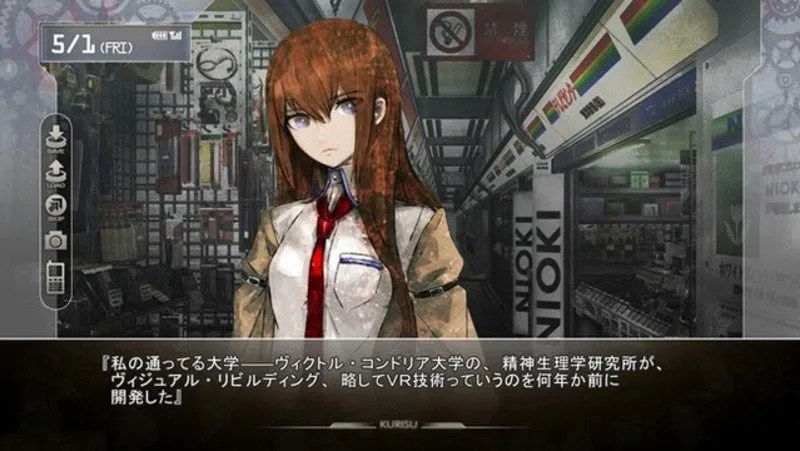
Also sharing the element of Visual Novel, where players can often affect the story through choices, in ChäoS;HEAd and ChäoS;Child, they are made by controlling the types of illusions that the characters will experience, it is possible to choose to give negative or positive delusions, and it is also possible to choose to stay in reality and not experience delusions. In Steins;Gate, it is possible to alter the story using the main character’s cellphone, the system is utilized through the ways the player responds to certain messages, phone calls, and also by taking it out of their pocket in specific situations. Besides everything affecting the narrative, it also gives you the chance to learn more about the main character Okabe Rintaro, to learn more about other characters, and how he should interact with them.
In Steins;Gate 0, the system was simplified, consisting only of answering or not answering the cellphone at certain moments. In many ways, the system is similar to the original; it is just a matter of adaptation on the part of the reader.
Robotic;Notes is similar to Steins;Gate, but using a tablet and its applications instead of the good old flip phone.
Development
The series is developed in collaboration between 5pb. and Nitroplus, planned by the CEO of 5pb., Chiyomaru Shikura. He opted for the series to be adjusted to present realism, as he believed that this would make the stories more relatable and believable; he personally stated that he found it difficult for people to buy into fantasy, not being convinced that they could get excited about exaggerated fantasy stories. The Steins;Gate team aimed for 99% science and 1% fantasy. Shikura commented that he was directly influenced by the 1989 film Back to the Future Part II, citing how the film remains believable enough to give a sense that it is really possible.

The Robotic;Notes team cooperated with JAXA, the Japan Aerospace Exploration Agency. The collaboration was made to bring more realism to the story. The concept of using a phone in the series was created by Tatsuya Matsuhara for 5pb., who initially wanted the game to use the player’s own cellphone, but changed his mind due to concerns that it could be against Japan’s privacy laws.
Soundtrack Development
The music present in the Novels was composed by Takeshi Abo and Zizz Studio. Abo noted that even though these games are part of a single series, they all have different atmospheres and convey different images, comparing with climatic atmospheres, ChäoS;HEAd would be rain, Steins;Gate cloudy, Robotics;Notes clear weather, and ChäoS;Child a storm. He used the same composition process for all the Novels; he started by reading the story to understand the scenarios and characters as much as possible, writing notes about the emotional flow of each and the situations that occur throughout the story, using them to build the worldviews of his music for the games, taking much consideration into their first impressions and appearances.
This approach, although slower than just assigning music to different areas of a game, allowed him to compose songs with superior quality, with a better appreciation according to his experience and past visions within the world of Science Adventure. He was given a lot of freedom to work on the series, making music that he would like to make for himself, something he enjoyed very much. Abo also composed the theme music for each game, and was especially happy with the theme music of Steins;Gate, Gate of Steiner, which he intended to represent the entire game as a whole.
Reception of the Series:
The series was a success for 5pb., the release of ChäoS;HEAd and Steins;Gate helped it establish itself as a game developer. In June 2011, Steins;Gate sales surpassed the mark of 300,000 (three hundred thousand) copies sold, Shikura saw this as an achievement for the genre. A year later, it was revealed that Robotic;Notes had over 80,000 (eighty thousand) pre-orders at its launch, a significant improvement compared to the release of Steins;Gate.
Steins;Gate 0 also performed very well commercially, with over 100,000 (one hundred thousand) copies sold on its first day of release, causing Steins;Gate along with Steins;Gate 0 to surpass the mark of 1,000,000 (one million) copies sold! The original version of ChäoS;Child, however, did not manage to reach the weekly sales list of the Top 50 of Media Create’s, selling only 1,415 copies. A bit disappointing, given the success of the other Novels in the series.
Overall, the games received positive reviews, both in Japan and the West. Many critics appreciated the story, music, visual elements, and the implementation of a new style of gameplay that accompanies Science Adventure, although some found it complicated and difficult to unlock certain routes. A writer from Anime News Network stated that the series contains well-developed mysteries and makes use of creative concepts, but that its conclusions are not always as good as its initial setup.
In 2009, Steins;Gate won the annual Famitsu Game of Excellence award. RPGFan included Steins;Gate as one of the 30 games in a list considered essential for role-playing gameplay from 2010-2015. It is considered one of the best Novels currently on the market. It was also nominated for the Golden Joystick Awards as the best portable/mobile game of 2015.
Science Adventure in Other Media
In addition to the Visual Novels, the series has expanded into adaptations in anime and various media spin-offs, such as the audio dramas Alpha, Beta, and Gamma, theatrical plays, light novels, and mangas, as well as various music albums with the soundtracks originally present in the games, along with albums with new arrangements. All current games in the series have anime adaptations. ChäoS;HEAd (2008), Steins;Gate (2011), Robotic;Notes (2012-2013), ChäoS;Child (2017), Steins;Gate 0 (2017).

Community
Comments
0 comments
There are no published comments in this language yet.
Send comment