

Meet the most popular Korean drink in the world, Soju!
Soju (hangul: 소주; hanja: 燒酒) is a popular drink not only throughout South and North Korea but also worldwide, and it is usually found in small bottles of 360ml or even 200ml.
One of the factors that helped increase this popularity is Korean dramas/movies and their celebrities and K-pop groups/bands (Korean pop).
This article is not intended to encourage alcohol consumption but is informative about the Korean drink soju. Drink responsibly!
Let’s learn a little more about this drink that is a favorite among Koreans and those who appreciate Korean culture/wave (Hallyu).
What is Soju?
Soju (소주) is a Korean distilled alcoholic beverage, popular for many years in South Korea.
The traditional ingredient for its production is rice, but it can also be found with other ingredients such as sweet potato, wheat, barley, and tapioca. Generally, its alcohol content varies from 16-17% to 45%.
Distilled beverage is a process that separates two distinct liquid substances, usually water from alcohol, from a liquid fermented from grains. With this separation, it is possible to add more alcohol, increasing the alcohol content, the “main objective” of a distilled beverage.
History
The origin of soju dates back to the 13th century (Goryeo dynasty) with the Yuan Mongols, who learned the distillation technique Arak from the Persians during their invasion between 1231–1259 in Korea.
The Mongols established bases in the capital Gaegyeong, Andong, Jeju Island, among other places, with plans to launch an expedition to Japan (invasion), where distilleries were built, transmitting the distillation process.
Over the centuries, soju was used both as a drink exclusively for the high society of the time and for medicinal purposes.
Over time, local residents learned to produce it at home, thus becoming a drink for anyone and not just the elite.
In 1965, due to rice shortages, the government prohibited the use of this ingredient to produce the drink, and that is when production began with other grains such as sweet potato, tapioca, wheat, barley, among others.
Even with the lifting of the ban in 1999 allowing manufacturers to use rice again, many still currently use various grains in production.
Nowadays, we find a wide variety of flavors and brands of this Korean drink.
Brands
There are so many brands of soju that it becomes difficult to know which one to choose, but there is one that has been the global leader for many years.
The company HiteJinro produces well-known brands such as Chamisul, which has 19% alcohol content, and Chamisul Fresh with 17.8%.
According to the website “Drinks International,” since 2001, Chamisul has been the number 1 distilled drink among 180 brands. In 2018, it sold over 78 million boxes of 9 liters worldwide.
We have other popular brands according to each region/province.
| Brand | Region/Province |
| Chamisul | Seoul, Incheon, and Gyeonggi |
| Chum-Churum | Gangwon |
| O2Linn | Daejeon and Chungcheongnam |
| Cool Cheongpung | Chungcheongbuk |
| Hite | North Jeolla |
| Charm | Daegu and Gyeongsangbuk |
| Goodday | Ulsan and Gyeongsangnam |
| White | Ulsan and Gyeongsangnam |
| C1 | Busan |
| Ye | Busan |
| Yipsejoo | Gwangju and South Jeolla |
| AHop Si Vahn | Gwangju and South Jeolla |
| Olle | Jeju Island |
The following image shows the favorite brands of Koreans in 2018 according to the website Statista:

In North Korea, there is also its own brand, the Pyongyang Soju, produced since 2009 at the food factory on the Taedong River.
Fruit Soju
Aiming to increase sales, the most popular brands started producing flavors of various fruits in their drinks.
Some of the most popular flavors are:
- Blueberry
- Lemon
- Plum
- Peach
- Strawberry
- Green grape
- Grapefruit
Brands like Hintejiro, C1, Chum Churum, among others, are the most well-known manufacturers.
Premium Soju
Following the principle of traditional production, we have some brands that produce premium sojus that not only promise a quality above the popular ones (in production), but the price is also significantly higher.
Andong Soju is made by a renowned family, specifically by Cho Ok Hwa currently, in the Andong region (possibly using the traditional method brought by the Mongols) that utilizes the best homemade techniques/methods passed down through generations.
The company/group Kwangjuyo, which manufactures ceramics, also produces one of the high-quality premium sojus.
The Hwayo emphasizes that in its production, they use the purest water, 100% Korean rice, and have over 700 years of tradition.
There are numerous sojus considered premium; Hitejinro itself produces, for example, the Chamnamootong Margeunisul and Ilpoom JINRO.
Drinks with Soju
Some complain that soju is a “tasteless drink,” simply because they do not like the traditional flavor of the best-selling brands or want to give it a new flavor by creating various drinks.
A good portion of drinks/bombs are mixed with beer from brands like Cass and Hite.
Below you will see the most popular ones among Koreans and foreigners:
Somaek (소맥)
It is nothing more than the mixture of soju and Korean beer (Maegju – 맥주), where the quantity of each item varies greatly, but it is usually 30% soju and 70% beer.
After mixing the two ingredients, a spoon is usually taken, dipped into the glass with the drink, and tapped at the bottom, creating a kind of whirlpool.
Poktanju (폭탄주)
It is similar in the mixture to somaek, but the difference is that the soju glass is dropped into the beer glass. It is often stacked in several glasses, knocking them down in sequence.
Kojinkamrae (고진감래)
This adds one more ingredient, resulting in; 1 glass of soju + glass of beer + glass of Coca-Cola (the size of the soju glass).
To prepare the kojinkamrae is simple. Inside the empty glass, the soju and Coca-Cola are added, and then the beer is poured in.
There are many other types of drinks, including one that goes Soju + Sprite + Yakult, but the above are the most popular. See below a video about:
In general, the soju glass measures 5cm x 5.5cm.
Etiquette When Drinking Soju
For those who know a little about South Korea, it is known that there, in addition to the language, there is a distinction in the way of speaking informally and formally (just like in Japan) for various situations.
When drinking with friends, bosses, and others, we also need to know how to behave in such situations.
When you meet a superior or an older person and they offer you a drink:
- Hold with both hands, one holding the glass with the palm and the other around it while keeping your head slightly bowed.
- When drinking, turn your face to the side, still holding with both hands, towards your superior/older person. If it is the first glass, drink it all at once.
Another way to show respect is to hold the glass with one hand and support the arm with the other while the person fills your glass.
If the person is a close friend, you can hold it with just one hand.
Side Dishes
Consuming alcoholic beverages on an empty stomach is not recommended, as it makes you less resistant to alcohol, making you more susceptible to getting drunk easily.
That is why we always see some type of dish and side dish when drinking soju, and they are varied from Korean cuisine.
Called Anju (안주 – Snack) the side dishes that are served together with alcoholic beverages.
Samgyeopsal (삼겹살)
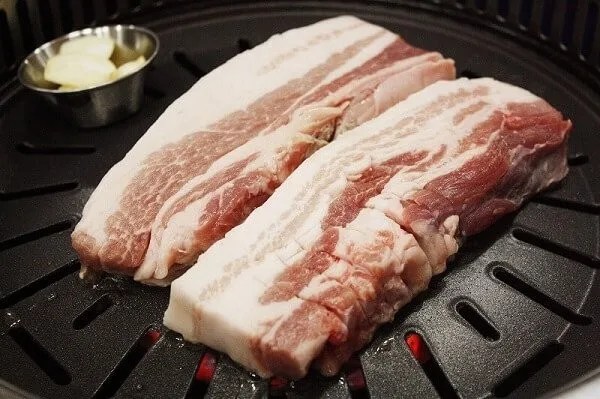
Samgyeopsal literally means pork belly, but in this case, it is skinless. Very popular among Koreans.
The meat comes raw for you to grill yourself and can be accompanied by lettuce, garlic, and other foods. It can be considered the barbecue of Koreans.
Jokbal (족발)
Jokbal, pig’s feet, is also one of the most requested foods by Koreans. It is usually found braised with soy sauce, ginger, garlic, and rice wine.
Dakbal (닭발)
These are well-spiced chicken feet that are fried or grilled and come with or without bones.
To eat, you need to use disposable gloves. They often appear in Korean movies and series.
There are many more snacks that are considered good to accompany an alcoholic beverage.
Soju in Dramas
It is rare not to see scenes in Korean series or movies where they drink some type of alcoholic beverage.
Many times they drink until they fall and do not remember what happened the night before. It is very common to see this. There are cases where they order Korean fried chicken (순살치킨) to have with some drink.

Soju always appears as it is a very cheap drink, about 1 USD, in South Korea and also has a strong commercial appeal. Many celebrities, whether actors or music groups, do commercials for this drink.
To give you an idea, actors like IU (Lee Ji-Eun), Suzy (Bae Su-ji), Lee Min-Jung, Hyuna, Song Joong-ki, Irene (Red Velvet), and many others have done or are doing commercials.
I believe that those sojus in boxes (soju box), sold for many years, also contributed to the increase in consumption of this drink among Koreans.
Notice that it can easily be confused with a juice that uses a similar package.
Recently, the South Korean government is reviewing the law on the promotion of alcoholic beverages in which celebrities appear on the labels.
It is normal for a Korean to drink after work, as it is seen as an extension of it. Those who refuse are looked down upon by their colleagues. It is a kind of gathering to become closer.
The drinking culture in South Korea is strong; it is not difficult to find people passed out on the street from drinking too much. What also helps is that on every corner, you can find a store that sells soju.
South Korea is the country that consumes the most alcohol in the world
Research shows that South Koreans drink much more than any other people in the world, with an impressive average of 13.7 shots of alcohol per person per week.
Not everything is perfect, right? If you drink, do so in moderation and enjoy the best of this culture that is trending today!
Originally published on Asian foods.

Community
Comments
0 comments
There are no published comments in this language yet.
Send comment