

TE (て) is one of the most fundamental forms in Japanese. Those who are starting to learn Japanese must have come across the form て (te). For those who haven’t reached that point yet, the て (TE) form is used to conjugate verbs, make requests, and list actions performed in the same sentence.
Therefore, I will explain right away how this form works in the Japanese language. Check it out:
1. Te form (て) – To make a request
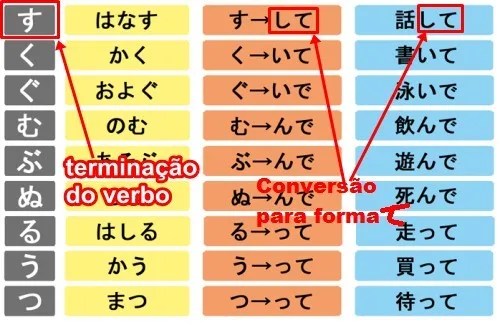
Firstly, this form is used to ask someone for something informally. To use this form, you need to change the ending of the verb to the て form. A basic example: Let’s use the verb 食べる (taberu) which means “to eat.” The ending of the verb is る. Therefore, in the て form, it would be 食べて (tabete) which means “eat.”
However, depending on the verb’s ending, you will not place exactly て in its place. Below is a list of how to use this form:
2. Te form (て) – For verb conjugation
This form is also used to conjugate verbs in the present continuous tense. It indicates that the person is currently performing some action. In this sense, it is comparable to the “ndo” form in Portuguese when we want to say that we are doing something.
To conjugate, combine the て form + いる as shown in the table below:
| Kanji (romaji) | Meaning | て form + いる | Meaning |
|---|---|---|---|
| する (suru) | To do | している (shiteiru) | Doing |
| くる (kuru) | To come | きている (kiteiru) | Coming |
| 飲む (nomu) | To drink | 飲んでいる (nondeiru) | Drinking |
| 遊ぶ (asobu) | To play | 遊んでいる (asondeiru) | Playing |
| 殺す (korosu) | To kill | 殺している (koroshiteiru) | Killing |
| 聞く (kiku) | To listen | 聞いている (kiiteiru) | Listening |
In summary, you will use the て form and add いる to the verb you are conjugating;
3. Te form (て) – To connect words
Similarly, this form can also be used to connect words. However, you use て to connect only verbs. For example, let’s use the following sentences:
今日は起きてました
Kyou wa okitemashita
Today, I got up
朝ご飯を食べました
Asagohan wo tabemashita
I had breakfast
学校に行きました
Gakkou ni ikimashita
I went to school
How do we connect these sentences? It’s simple. Using the て form, the three sentences become:
今日は起きて、朝ご飯を食べて、学校に行きました。
kyou wa okite, asagohan wo tabete, gakkou ni ikimashita
Today I got up, had breakfast, and went to school
Thus, the three sentences are connected to establish a chronological order of events. However, only the last verb remains in the polite form (ます form). If you are going to write a sentence in the polite form, always leave the last verb in the ます form.

Community
Comments
0 comments
There are no published comments in this language yet.
Send comment