

Have you ever wondered how the Japanese express their feelings? Did you know that there are several ways to say love in Japanese? In this article, we will deeply explore three of the main ways to express love in the Japanese language: Ai (愛), Koi (恋), and Suki (好き).
In Japan, saying “I love you” is not as simple as it may seem, as each expression carries a unique and special nuance. Depending on the context, relationship, and even the region where you are, the words can have completely different meanings. And of course, we don’t stop at just the most famous words: you will discover other fun and interesting variations that add a special charm to the Japanese language.
So, how about understanding definitively how to express your love in Japanese?
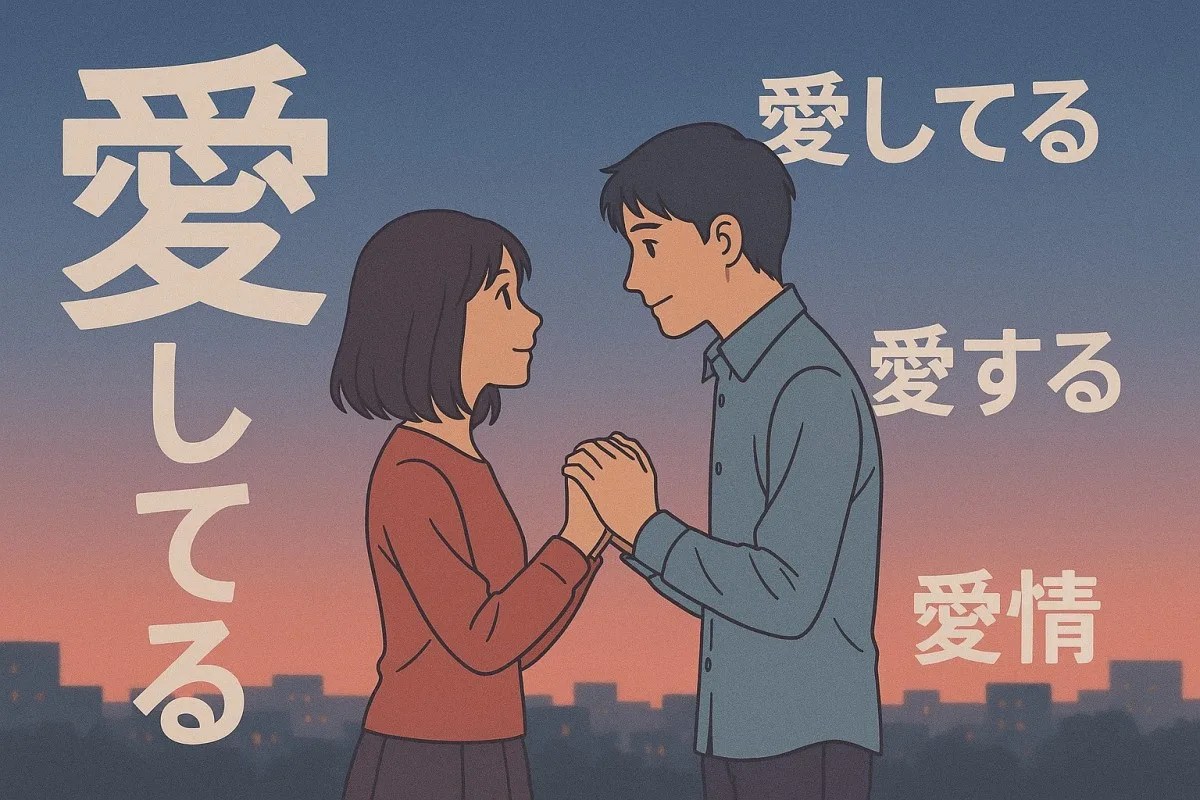
Ai (愛): The Deep and True Love
“Ai” literally means “love” and represents a deep, solid, and lasting feeling. In Japan, this word is reserved for truly special and serious moments. You will hardly see someone casually saying “aishiteru” (愛してる), which is the complete form to say “I love you,” as this implies a very high level of intimacy and commitment, usually between married couples or people in very serious relationships.
If you are in a long-term relationship or want to demonstrate your commitment in a strong and definitive way, this is exactly the expression you should use. However, use it sparingly: for the Japanese, less is more when it comes to such powerful words.
Koi (恋): Fiery and Romantic Passion
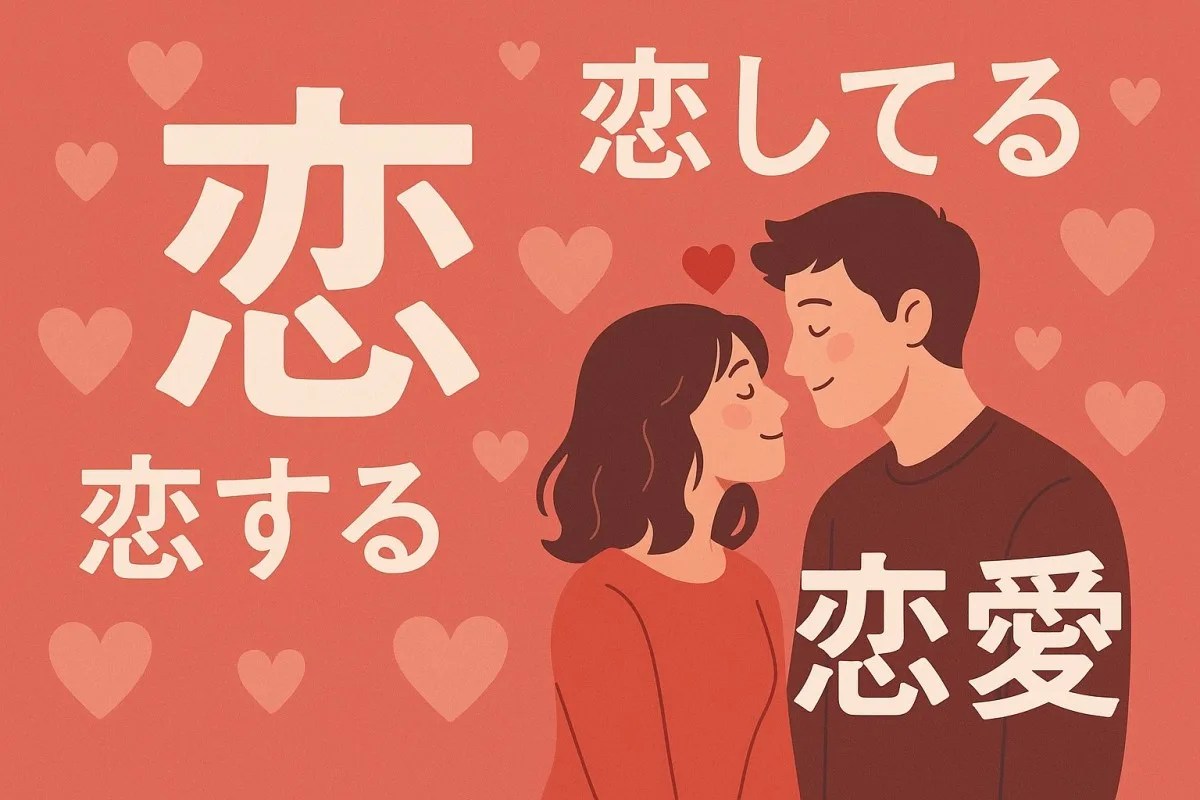
Unlike the deep “ai,” the term “koi” expresses an intense passion, something that is blossoming. Imagine those feelings at the beginning of a romance, the excitement of the first exchanges of glances and the first dates. That is exactly “koi.”
“Koi” can evolve into “ai,” but initially represents that initial romantic spark. A common expression with “koi” is “koishiteru” (恋してる), which means something like “I am falling in love with you.” It is the perfect way to express your feelings when everything is still new and exciting.
By the way, did you know that the symbol of romantic and youthful love in Japan is often represented by cherry blossom petals? This is exactly how many Japanese describe the fleeting beauty of a new love.
Suki (好き): Simply Liking (But with a Touch of Love)
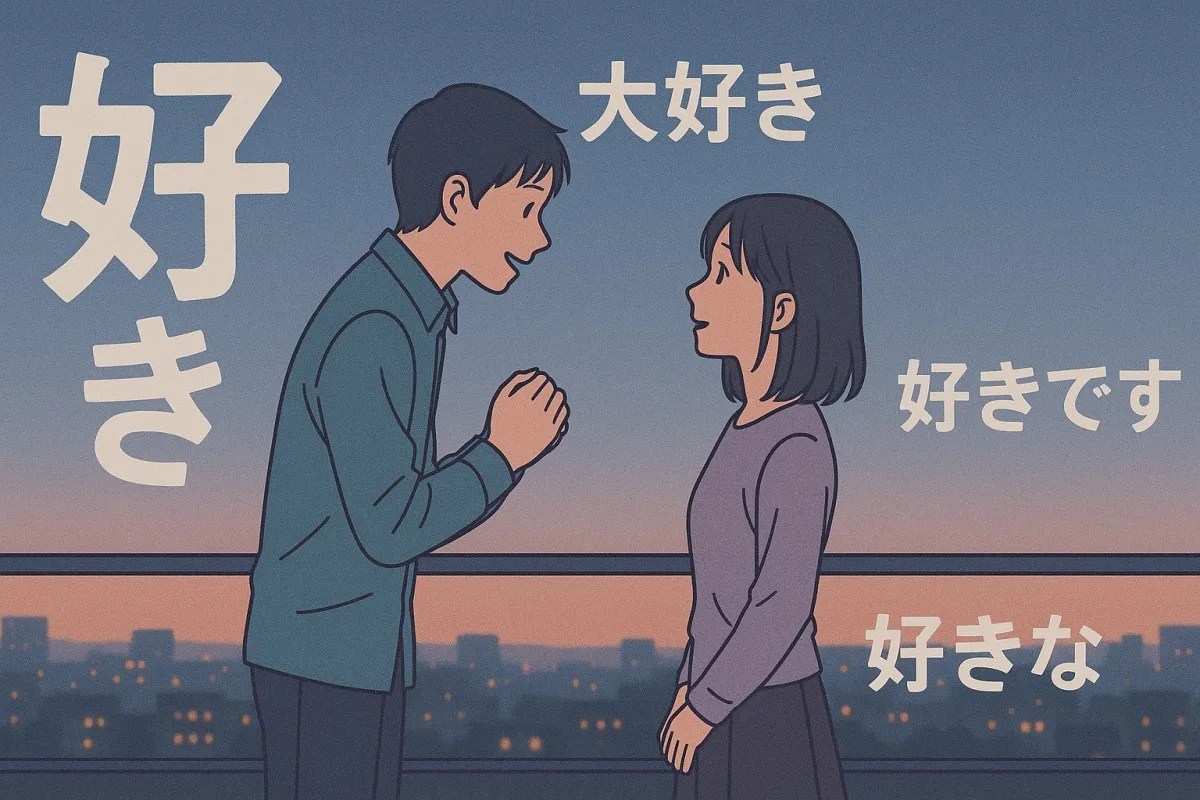
“Suki” is undoubtedly the most common and versatile way to express affection in Japan. Literally translated as “to like,” it can mean anything from a simple interest or admiration to a true “I love you,” depending on the context. Want to say you really like something or someone? Use “daisuki” (大好き), which literally means “to like a lot.”
Here’s an interesting fact: the word “suki” is so present in everyday Japanese that it named our site “Suki Desu“, which means exactly “I like.” Simple, direct, and affectionate. Isn’t it perfect?
If you are unsure about which word to use, go for “dai suki desu.” This is the main way to declare your love in Japanese; using this simple form does not mean that your love is less than using koi or aishiteru.
Rabu (ラブ) – Love Derived from English
In addition to these traditional forms, the Japanese have also incorporated some modern variations from other languages, mainly English. One of the most popular among young people is “rabu” (ラブ), directly derived from the English “love.” And when things get more romantic, the Japanese often say that the couple is “raburabu” (ラブラブ), equivalent to saying they are super in love or in the perfect romantic mood.
Another cultural curiosity that symbolizes marital love in Japan is the tsuru bird, known worldwide for origami. A pair of tsurus represents eternal fidelity and luck in love. It is no wonder that many Japanese weddings decorate their celebrations with these beautiful paper birds.
Love Present in Japanese Ideograms
- 色 – Even the simple kanji for color can relate to love, lust, and sensuality;
- 情 – Kanji present in some words related to love that can indicate feelings, emotion, passion, affection, and care;
- 慕 – To follow, idolize, love, adore, admire, have affection, desire;
- 挑 – Excitement, stimulation, provocation;
- 参 – This ideogram means confused, but can depict feelings of being in love, defeated, or madly in love;
Other Words Related to Love in Japanese
- 恋愛 – renai – Means love, affection, making love, passion, and falling in love;
- 愛好 – aijou – Means adoration;
- 情け – nasake – Sympathy, mercy, affection, and love;
- 恋慕 – renbo – Tender emotions, passion, and love;
- 片思い – kataomoi – Unrequited love;
- 愛読書 (aidokusho) – Favorite book
- 愛人 (aijin) – Lover
- 愛情 (aijou) – Love, affection
- 愛犬家 (aikenka) – Dog lover
- 愛国心 (aikokushin) – Patriotism
- 愛車 (aisha) – Favorite car
- 愛用する (aiyousuru) – Favored, habitual
- 母性愛 (boseiai) – Maternal love
- 博愛 (hakuai) – Philanthropy
- 初恋 (hatsukoi) – First love
- 悲恋 (hiren) – Tragic love, sad love, ruined love
- 恋人 (koibito) – Boyfriend
- 恋文 (koibumi) – Love letter
- 恋敵 (koigataki) – Rival in love
- 恋に落ちる (koi ni ochiru) – To fall in love
- 恋する (koisuru) – To be in love with
- 恋愛 (renai) – Romantic love
- 失恋 (shitsuren) – Disappointing love
Love in Japanese Tattoo and Gaara
A very common act is to get a love tattoo in Japanese [愛], even Gaara from the anime Naruto has this red tattoo on his forehead. Undoubtedly, if you want to tattoo love in Japanese, the ideogram AI [愛] is the most indicated. If you wish, you can also tattoo the ideogram of passion KOI [恋] or a mix like [恋愛].
Using koto to say I love you in Japanese
You may have noticed that in Japanese culture the expression Koto [事] is used when someone expresses their feelings by saying I love you, as in the expression: anata no koto ga dai suki desu [あなたのことが大好きです]
By adding Koto, the phrase approaches “I love everything about you” or “everything in you.” This indicates a romantic and genuine love, focused on the inner qualities and non-visible aspects of the person.
Instead of a simple “I like you,” Koto conveys the depth and breadth of feelings. It is especially important with the expression “Suki Desu” to emphasize a deeper love and not just a simple affection.
We also recommend reading: Thing in Japanese – Meaning of Koto and Mono
The act of declaring and exposing your feelings in Japanese even has an expression called Kokuhaku [告白]. This word literally means to confess or declare feelings. Generally, the Japanese do this alone.

Tsuki ga Kirei [月がきれい] – The moon is beautiful
A poetic way to say I love you in Japanese is the expression “The moon is beautiful,” or Tsuki Ga Kirei [月がきれい]. It all started with the famous writer Soukeki Natsumi (1867-1916) who answered the question How do you translate “I Love You” into Japanese?
This writer is so famous that his face is printed on the 1000 yen note. This expression also makes perfect sense, especially for those who cannot easily confess their love and use expressions like this.
It has appeared in various animes; there is even an anime with this name that well represents the meaning of this expression.
月がきれいですね
tsuki ga kirei desu ne
It is very likely that this expression was chosen for the similarity between the word Tsuki [月] and Suki [好き], not to mention the fact that it uses the word beautiful, like the Moon, a quite romantic symbol.

Ki ni naru and Ki ni itteiru – Liking Someone
Although Suki [好き] is commonly translated as liking, it is generally used to show real romantic feelings for the person. And when we are just starting to like or enjoy someone? There are other expressions for that purpose.
- Ki ni itteru [気に入ってる] = Enjoying, liking;
- Ki ni naru [気になる] = Starting to like or enjoy;
An expression widely used by young people, especially in Reality Shows. Its use can also apply to things and objects. Even the like button on the internet is written using similar ideograms.
Suki Desu in 47 Different Dialects
Everyone knows that a language has dialects, slang, and accents. In Japan, this is even greater as the country is divided into 47 states, it has existed for thousands of years and also has a complexity in the pronunciation of the language due to the various readings of its ideograms.
To conclude this article, we will share a list of 47 different ways to express the term Suki Desu (好きです), often translated as “I love you” in different 47 dialects of Japan:
- Aichi: Dera suki ya ni
- Akita: Suttage suki da
- Aomori: Tange da ba daisuki da yo
- Chiba: Daisuki
- Ehime: Daisuki yakken
- Fukui: Daisuki ya za
- Fukuoka: Bari suitoo yo
- Fukushima: Suki da
- Gifu: Meccha suki ya yo
- Gunma: Nakkara daisuki nan sa ne
- Hiroshima: Bari daisuki jake
- Hokkaido: Namara suki dassho
- Hyogo: Meccha suki ya de
- Ibaraki: Daisuki de shaanme
- Ishikawa: Suki ya yo
- Iwate: Zutto daisugi da sukai
- Kagawa: Suitoru ken
- Kagoshima: Wazzee sujjadoo
- Kanagawa: Daisuki
- Kochi: Kojanto suki yaki
- Kumamoto: Daisuki bai
- Kyoto: Honma ni suki ya de
- Mie: Meccha suki ya de
- Miyagi: Suki desu
- Miyazaki: Tege suki yaccha ken
- Nagano: Daisuki da yo
- Nagasaki: Suki bai
- Nara: Honma ni suki ya de
- Niigata: Daisuki da kan na
- Oita: Zutto zutto daisuki bai
- Okayama: Deeree suki jaken
- Okinawa: Deeji daisuki saa
- Osaka: Meccha daisuki ya de
- Saga: Gabai suitoo yo
- Saitama: Eree suki nan yo
- Shiga: Daisuki ya de
- Shimane: Daisuki da ken
- Shizuoka: Bakka suki da
- Tochigi: Honto daisuki da yo
- Tokushima: Honma ni daisuki ya ken
- Tokyo: Daisuki
- Tottori: Meccha suki
- Toyama: Suki ya cha
- Wakayama: Meccha suki ya de
- Yamagata: Honten daisuki da kan na
- Yamaguchi: Buchi suki jakee
- Yamanashi: Daisukkitsukon

Community
Comments
0 comments
There are no published comments in this language yet.
Send comment