

Today we are going to talk about fireworks, which in Japanese is called Hanabi [花火], and also about one of the most iconic festivals in Japan, Hanabi Taikai [花火大会]. Ready to enjoy the fireworks in Japan?
In Japanese, fireworks are written as hanabi [花火], which literally means “fire flower,” similar to the English word fireworks, which means work with fire. It can also be called Pyrotechnics, which in Japanese is enka [煙火].
Fireworks in Japan
Pyrotechnics is the technique of playing with fire to entertain people. This technique evolved into what we know as fireworks. It is believed that everything originated in Asia, already in Prehistory, but gunpowder fireworks came from China.
Originally, fireworks were used to ward off evil spirits. Unlike the West, the Japanese do not use fireworks to celebrate the New Year. In Japan, fireworks are famous during the summer, thanks to festivals and holidays.
Japanese fireworks come in all various sizes that break world records, as well as create various designs and animations in the sky. Throughout the article, we will see some models of Japanese fireworks.
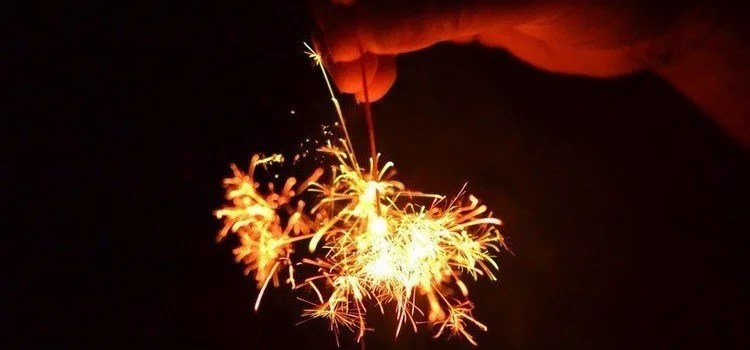
An interesting type of hanabi is the senkou hanabi, a stick about 20 centimeters long, similar to an incense burner. With it, you can observe the fireworks safely from your own home. You can buy it at a konbini.
There was a time in Japan when fireworks were prohibited. In 1648, the shogunate banned fireworks except on the Sumida River. But in 1948, after a festival on the Sumida River, they were allowed throughout Japan, enabling the holding of fireworks festivals in Japan, the famous Hanabi Taikai.
Hanabi Taikai – Fireworks Display Festivals
During the summer, the famous Hanabi Taikai [花火大会] or fireworks festivals take place, mainly in July and August. The first festival was held in 1733. The festivals usually occur at beaches and rivers, attracting large crowds.
At these festivals, people often wear yukata (summer kimono) and sometimes bring things to have a picnic. In most of these places, you can find numerous food stalls and typical summer items.
At these stalls, as usual, you find typical festival items such as food, masks, games like fishing for goldfish, shooting games, and others. Some also visit the temple during the festival.
These festivals are grand and attract tourists from all over the world. In almost every anime, you can come across characters going to this summer festival, which is traditionally a place for romantic couples to fall in love.
There are various festivals of fireworks throughout the country, with numbers exceeding 1,000, and about a third are famous nationwide. Among the most famous are those in Yokohama, Sumidagawa in Tokyo, Nagaoka, Miyajima, Lake Biwa, and many others.
At the end of this article, you will find various videos about Hanabi Taikai to complement your reading. The article will now conduct an in-depth research into the history of hanabi, other festivals, and also types of Japanese fireworks.

The History of Fireworks in Japan
Fireworks have played multiple roles throughout the history of Japan. They were used for mourning celebrations for the dead, as well as celebrations of life, to scare away spirits, and for entertainment for the population.
It is not known when, where, and on what occasion fireworks were first used in Japan. One of the few pieces of information we have is found in the chronicles Kennai-ki of the lord of the Muromachi Period, Manriokoji Tokifusa, from May 5, 1447.
It mentions that after a Buddhist service at Joka-in, “Tojin” performed a fireworks display in the temple grounds. It is said that the fireworks were made by creating a bamboo frame and using fire to create shapes of “light and sound”.
Designs such as water wheels, forward and backward movements on a rope, falling meteors, and many other arts were made. Manriokoji Tokifusa praised them and rewarded them as “a rare art of fire”.

It is believed that fireworks were brought from another continent after the opening of trade by Ashikaga Yoshimitsu along with gunpowder weapons. Soon after, they began to be manufactured in Japan.
There are also many records of fireworks made by foreigners, such as Christian missionaries. There are records dating fireworks used by Christians in Japan on April 14, 1582, in Usuki, Oita Prefecture.
There is a theory that in 1585, in the city of Tochigi, Minakawayama Jōshō and the Satekishu set off fireworks as a truce in the war. There is another theory that fireworks were made at Azuchi Castle, but it was probably bamboo burning.
There are records of “fireworks observation” from the Warring States period to the beginning of the Edo Period, such as a record that Date Masamune observed fireworks displayed by “Datarajin” at Yonezawa Castle on August 17, 1589.
Another record states that Tokugawa Ieyasu, in August 1613, spoke about a fireworks display by a Ming merchant who accompanied him when he had an audience with the British ambassador John Salis at Sunpu Castle.

Tezutsu Hanabi – Traditional Bamboo Fireworks
Tezutsu Hanabi [手筒花火] refers to traditional fireworks set off by holding them in a kind of bamboo cannon. This tradition mainly takes place in the city of Toyohashi since 1560, in addition to other presentations made around the world.
The cannons themselves are made from a large hollow piece of bamboo nearly a meter long, tightly wrapped around the outside with a rope. The tubes are then hand-packed with several kilograms of black powder by the performers themselves.
In fact, everything from cutting the bamboo to weaving the ropes is traditionally done by the artists themselves. As if the craftsmanship of the fireworks were not impressive enough, the artists then grab them with both hands, light a match, and hold them high while a rain of hot sparks falls on them for 30 seconds or more.
It is believed that the cannons originated from an ancient type of signaling lantern similar to those used on the Great Wall of China. Ancient records write of Shogun Tokugawa Ieyasu observing such fireworks at Edo Castle.
Although gunpowder was strictly prohibited at this time, peasants could use it to light fireworks at Shinto shrines. Tezutsu Hanabi are still linked to Shinto festivals today, mainly at Yoshida Shrine in Toyohashi.
Tezutsu Hanabi festivals can be seen throughout eastern Aichi, as well as in western Shizuoka and parts of Gifu. The festivals also take place in the summer just like the Hanabi Taikai.

Tsunamibi – Fireworks with Puppets
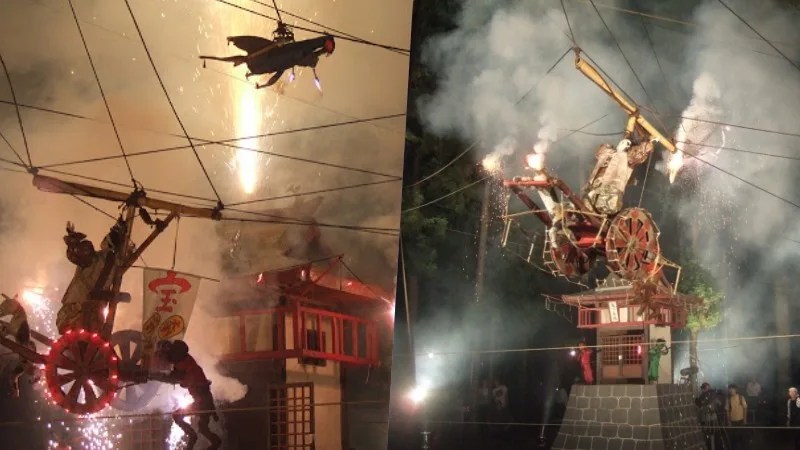
Tsunamibi [綱火] is a fireworks display that combines puppet dolls and fireworks, manipulated with strings stretched in the air, flying dolls, and music. The festival is held every year on August 24 at Atago Shrine.
The origin of this Tsunamibi is unknown, but it is said that a black spider and a red spider were seen weaving a web in the air on the day of the festival at Atago Shrine during the Keicho era. Generally, the presentation has traditional similarities to this.
The tsunamibi style began by attaching torches and lanterns to the puppets, and after the introduction of gunpowder, they researched the technique of making fireworks, attached them to the puppets, and dedicated them to a shrine to pray for the safety of the village.
This type of firework is also called “Sanbonza Karakuri Hanabi“. It is said that the “Lord of Obari Castle, Ishimi Mamoru Matsushita” invented this ceremony at the end of the Warring States period to celebrate victory in war and also to pray for the fire bug.
Hanabi no Hi – Fireworks Day in Japan
In Japan, hanabi no hi [花火の日] or Fireworks Day is celebrated. Fireworks Day was established on August 1, 1967, to commemorate the lifting of the ban on fireworks on August 1, 1948.
The festival also commemorates August 1, 1955, the day of the massive fireworks explosion at the Umabayashi Bridge in Tokyo, as well as August 1, the day of the largest Oyasama Festival in the world, the PL Fireworks Art Festival.
It is also said that May 28 is hanabi no hi because of the famous Ryogoku River Festival. On this day in 1733, the first firework in Japan was launched at the opening of the Ryogoku River [両国大川] to comfort the souls of the victims of famine and cholera the previous year and to expel evil spirits.
Chichibu Ryuse Hanabi – Ryusei Matsuri
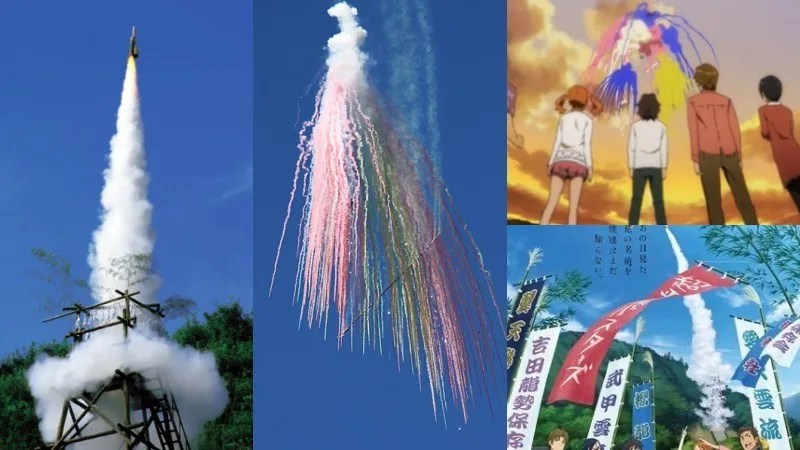
For hundreds of years since the Tensho Era, local farmers have launched giant fireworks that resemble rockets as part of an annual Shinto festival in the city of Chichibu. This type of firework can be seen in the anime Ano Hana.
The Chichibu Ryuse Hanabi [秩父龍勢花火] fireworks are an incredible 20m long, weigh up to 50kg, and shoot up to 300 to 500m high. About 30 rockets are launched during this festival day.
Each year, the festival takes place on the second Sunday in October, and the rockets are launched all day long, with intervals of 15 minutes. There is a break of about an hour starting at 11 a.m. for a ceremony to be held at Miku Shrine, which is about 300 meters from the launch site itself.
The name of the festival (Ryusei Matsuri) means “dragon power” – and it is said that the rockets resemble a dragon ascending to the sky. The locals are not exactly sure of the origin of this tradition passed down through generations, including the distinct techniques for making these fireworks.
The locals carry the 20-meter fireworks on their backs to a launch platform, each rocket is announced, prayers are made, and when it reaches the necessary height, the rockets explode, creating the beauty of the fireworks in the blue sky.
Senko Hanabi – Sparklers
Senko hanabi [線香花火] are traditional Japanese fireworks that resemble incense. Their origins date back to 1927, and in the West, they can be found under the name Sparklers. Of course, there are differences between the traditional Japanese version and the ones sold in the West.
In Japan, the fire is on a thin axis of twisted tissue paper about 20 centimeters long, where its end contains grains of black powder. The black powder composition consists of three basic chemicals: potassium nitrate, sulfur, and charcoal.
This type of fire releases delicate sparks with a range of up to 20 centimeters. They are lit away from the wind and held with a firm hand so that the delicate melted head does not fall. Senko hanabi are included in firework packages and are ignited last among other hanabi.
It is said that Senko hanabi somehow hypnotizes the silent observer and evokes the unconscious mono, describing a flash of sadness felt when reminded of the beauty and brevity of life.

Videos about Hanabi Taikai in Japan
To conclude, let’s leave some videos showing a bit of this beautiful festival:
Video of Japan through other eyes!
Stalls and Festival!
The Fireworks!
The Main Hanabi Taikai in Japan
Sumidagawa Hanabi Taikai

Nagaoka Hanabi Taikai
In terms of firepower, the Nagaoka Taikai in the city of Nagaoka in Niigata Prefecture is perhaps the largest in Japan. Massive shells are used to fill a huge section of the night sky, 2 kilometers long.
Jingu Gaien Hanabi
This one stands apart from all other Hanabi Taikai held in Japan. While almost all Hanabi Taikai are free, this one costs an absurd 40,000 yen. This is because along with the fireworks show, a J-Pop music show or other famous performances are usually presented.
Other Popular Hanabi Taikai
If you are in Tokyo, other famous similar events are Tokyo Bay Hanabi and Yokohama Hanabi Taikai held in the futuristic port area of Odaiba and Minato Mirai. Below is a list of popular festivals:
- Nagaoka Hanabi
- Miyajima Fireworks Festival
- Omagari National Fireworks Competition
- Chichibu Night Festival
- Edogawa Hanabi
- Tamagawa Hanabi
- Kamakura Hanabi
- Uji Hanabi
- Itabashi Hanabi
- Ichikawa Hanabi
- Katsushika Noryo Hanabi
- Chofu Hanabi
- Gion Kashiwazaki Hanabi
- Tenjin Matsuri
- Atami Hanabi
- Wakakusa Yamayaki
Hanabi – Card Game
Hanabi – the Japanese word for “fireworks” is also a cooperative card game in which players try to present the perfect fireworks display by placing the cards on the table in the correct order.
Sounds easy, right? Well, not quite, because in this game, you hold your cards so that they are visible only to the other players. That’s right, you cannot see your own cards!
You must work as a team, giving each other hints about the values or colors of each other’s cards to create a stunning fireworks display before your cards run out. You can buy the game below:
In addition to the Card Game, we also recommend on Amazon Prime the movie “Hana-Bi: Fireworks,” a masterpiece by Takeshi Kitano that has been acclaimed with numerous international awards, including the Golden Lion at the Venice Film Festival.
Hanabi Hyuga – Naruto Character
Something frustrating might be someone searching for Hanabi looking for fireworks and coming across a Naruto character that is trending in Google searches. Her name is written in katakana [日向ハナビ], but it certainly refers to fireworks.
She is the youngest daughter of the head of the Hiashi Hyuga clan and the younger sister of Hinata Hyuga, and cousin of Neji Hyuga. Hanabi is considered more powerful and confident than Hinata; Hiashi decided to focus his strict training regimen on Hanabi instead of Hinata.
Hanabi has dark brown hair with bangs and white eyes. In general, Hanabi bears a strong resemblance to her cousin Neji Hyuga. She has been seen wearing a sleeveless blue V-neck shirt and blue shorts.

Community
Comments
0 comments
There are no published comments in this language yet.
Send comment