

The 5 yen coin, goen, Japanese which is equivalent to 15 cents is considered a symbol of luck in Japan and around the world. Why? In this article, we will examine some details of this coin and understand its meaning.
5 yen is a low-value coin, second only to 1 yen. It is also a holey coin, perfect for making strings, keychains, and placing in other accessories. The coin dates back to 1870 and its front represents rice growing out of water. The elements depicted on the coin represent agriculture and fishing, which are key elements of the Japanese economy.
Read also:
Getting to know the Yen – The currency of Japan
Calculating the Yen through Japanese eyes! How to know if it is expensive or cheap?
Why is the goen considered a lucky coin?
The 5 yen coin is considered a lucky coin simply because its pronunciation is the same as the word 御縁 (goen), which can mean destiny, opportunity, connection and relationship. So basically, the coin 5円 is an object of luck in love.
Separately, the Kanji of the word 御縁 can mean:
- 御 – honored, manipulate, govern, educated, humble, beautiful;
- 縁 – affinity, relation, connection, edge, border, brink;
The first Kanji can be used as a prefix and suffix in some words. The second kanji is used in nouns and indicates a force or connection that links two people. Just because of this similarity in pronunciation between 5円 and 御縁, thousands of people use the coin to have luck in love and other important connections.
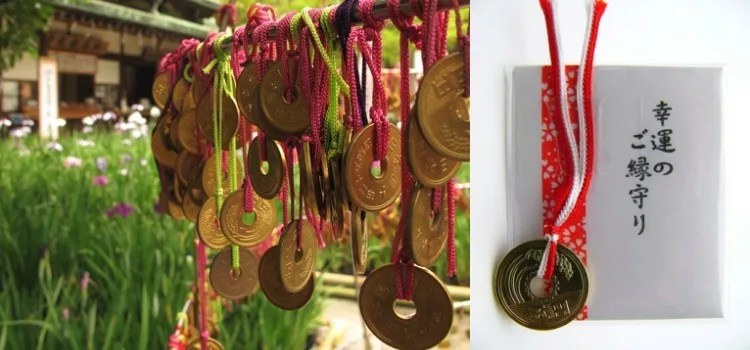
How is the 5 yen coin used?
Besides being used as a symbol, in strings and accessories. These coins are given as donations in Shinto shrines with the intention of establishing a good connection with the deity of the shrine.
Others throw these coins in temples in the hope of meeting new people who may bring fortune, business, friendships, or love. Some believe that the five yen coin should be the first to be placed in the wallet.
Others still believe that throwing the 50 yen coin, which is also holey, brings five times more luck than the 5 yen coin. Japan is full of superstitions because of the pronunciation of words; some even believe that the numbers 4 and 9 bring bad luck because of their pronunciations shi which resembles death (shinu) and ku which resembles suffering or black.
Others believe that Kit Kat chocolate brings luck because of its pronunciation which resembles kitto katsu meaning “you will surely win,” causing parents to buy chocolate for their children during exam times. This and many other superstitions can only be found in Japan.
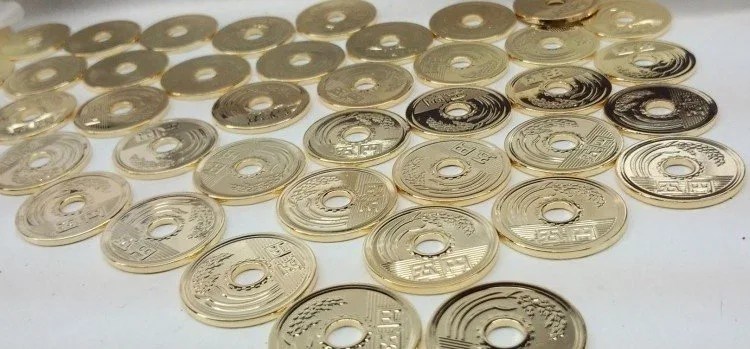
Why are the 5 and 50 yen coins holey?
Many are curious about the hole in the middle of the Japanese coins of 5 and 50 yen. Even if you ask most Japanese people, no one will know how to explain why there is a hole in the 5 yen and 50 yen coins. In this article, we will try to understand why there is a hole in the middle of Japan’s coin.
Know that it is not only the Japanese coins that have a hole in the middle. Several countries such as Norway, China, Papua New Guinea, and Denmark have had or have holey coins.
There are rumors that the holey 5 yen coin was originally created in 1948 because they needed to save metals that became scarce after World War II. Originally, the 50 yen coin had no hole, but it was very similar to the 100 yen coin. So they made a hole in the 50 yen coin to help identify them. The holes in the Japanese coin are currently a great help for the visually impaired.
We conclude that in the past, various coins from different countries had a hole in the middle to prevent counterfeiting and reduce production costs. However, with the advancement of technology, many countries abandoned the practice of making holey coins. Few countries besides Japan currently have a holey coin.

Explaining in depth why the coins are holey
Although we know the main reason why the 5 and 50 yen coins have a hole in the middle, there are still many doubts regarding the origin of the holes in the coins. This is because for over 1300 years, there have been various Japanese coins with a square hole in the middle, even during the Edo period (1603 – 1868).
China may have influenced the holey coins of Japan as it influenced much of Japan’s history and culture. There are theories that the circle of the coin represented the universe and the square in the middle of the coin represented the earth. Thanks to this hole, the coins were tied to the waist, which facilitated transport and protected them from thieves.
The hole in the coin had various uses such as serving as buttons for clothing or making necklaces. Some were even used in the manufacture of weapons. In ancient times, coins were manufactured in a way that removing and separating them during their minting was very laborious; the holes in the middle somehow facilitated this process.
The holey coin has existed for thousands of years! So there are still doubts about who had the idea to punch the coin and why? Was it just because of the cost and difficulty of manufacturing? Or was it for practicality? What is your opinion?
Below are curiosities about the Yen:
Does the Danish coin not have a hole in the middle?
Why the hell am I talking about the Danish coin in an article about the 5 yen coins? A few years ago I created an article with that name, but when updating both the Japanese coins, I decided to include this part in the middle.
A few years ago, looking at the reports from Google Search Console of my site, I noticed that the old post about Why are the Japanese coins of 5 and 50 yen holey appeared several times, like, more than 200,000 times for people who searched for “Which Danish coin does not have a hole in the middle“.
The strangest thing is that even though my article appears only on the second page when searching for “Which Danish coin does not have a hole in the middle,” still more than 1000 people entered the article about the holey Japanese coins. It may not seem like much to you, reader, but for me, it was a totally strange phenomenon.
This phrase was searched so many times that it appeared several times in the TOP 10 impressions of keywords on my site, even though the article was located on the second page. So I thought, I will honor this gigantic amount of searches and write about it and also try to unravel this mystery.
It was on this occasion that I could see the luck that the 5 and 50 yen coins brought to my site… lol!

Despite my Google Search Console showing that there were more than 200,000 monthly queries for this keyword, and more than 40 variations of the phrase, the number could be much higher. Google’s keyword planner suggests that the search is only from 1000 to 10,000 people, despite the Search Console showing differently.
This exorbitant amount of searches for the phrase “which Danish coin does not have a hole in the middle” appeared only in the last month, probably when my article about holey coins from Japan ranked on the second page for this keyword. I am using many technical terms that are confusing you, but I am also confused.
Which Danish coin does not have a hole in the middle?
If you came from Google, please answer why you searched for this phrase. It is incomprehensible the abnormal amount of queries for this phrase appearing in my Search Console, which made me write this article and answer this question.
The name of the currency of Denmark is Danish Crown, which is equivalent to 0.58 cents, and is also used in Greenland. Its code is DKK and the coins are divided into øre, where 100 øre equals 1 krone (Danish crown). There are 25 and 50 øre coins, as well as 1, 2, 5, 10, and 20 krone coins. The notes are 50, 100, 200, 500, 1000 kroner.
The only Danish coins that have a hole in the middle are the 1 krone, 2 krone, and 5 krone. Both the øre coins and those worth more than 5 krone do not have a hole in the middle and are beautiful. Perhaps this is the reason you are searching for Danish coins without a hole in the middle, but what usually catches attention in coins are the holey ones.
Sometimes I seriously think it is some kind of conspiracy or secret method to find some secret site. We are talking about more than 200,000 monthly searches for this phrase. If it were something like Danish coins, kroner, and øre, but I am talking about the phrase: Which Danish coin does not have a hole in the middle…
After a few years, I discovered why several people entered my article about 5 yen coins using Danish coins. This happened because of a TV program that asked this question… How powerful programs are…

Community
Comments
0 comments
There are no published comments in this language yet.
Send comment